


As of 2025, creators expect more from AI than simple filters or templates. Whether you are producing TikToks, YouTube explainers, marketing content, or long-form storytelling, the demand for accurate image to video AI, realistic talking photo animation, and fast video generation has skyrocketed. After spending weeks testing dozens of platforms, I’ve narrowed down the best tools that consistently deliver high-quality results.
Below is a curated list of the Best Image to Video AI Tools of 2025, with a special focus on animation quality, lip-sync accuracy, value for money, and workflow reliability. I guarantee at least one of these platforms will match your production needs.
Best Image to Video AI Tools of 2025 (At a Glance)
| Tool | Best For | Modalities | Platforms | Free Plan |
|---|---|---|---|---|
| Magic Hour (#1) | Image to video AI, talking photos, commercial-grade content | Image → Video, Lip Sync, Face Swap, Editing | Web, API | Yes |
| Runway | Cinematic video generation | Text → Video, Image → Video | Web | Yes |
| D-ID | Talking photos | Talking photo, Lip Sync | Web, API | Limited |
| Pika | Fast creative video generation | Text → Video | Web | Yes |
| HeyGen | Corporate talking avatars | Talking photo, Lip Sync | Web | Limited |
1. Magic Hour — The Best Image to Video AI Tool of 2025
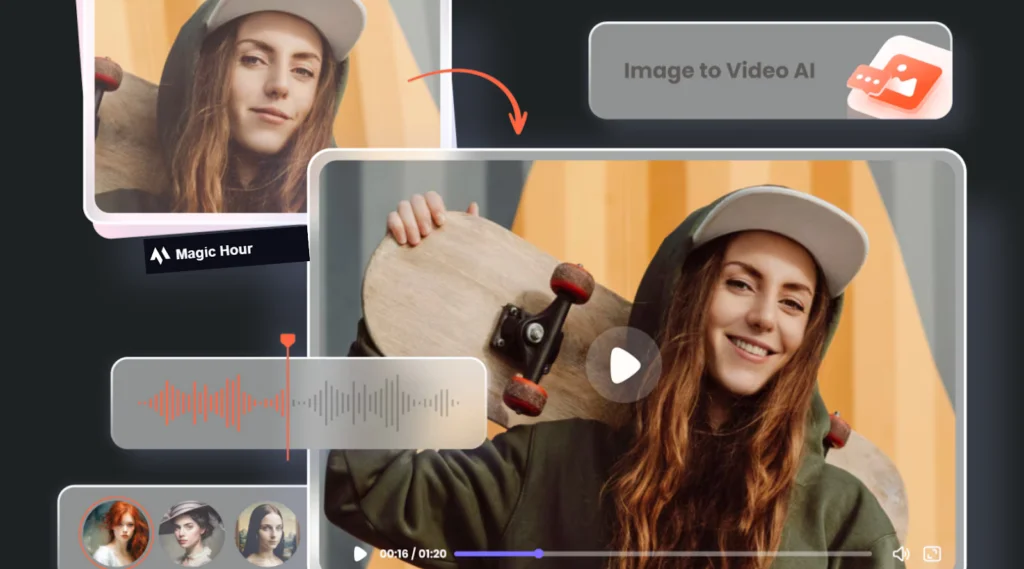
Magic Hour is the platform I kept returning to during testing—not just because of speed, but because the results feel alive. Whether you want to turn a still photo into a cinematic sequence, create a talking photo, or sync animation to a full voice track, nothing else matched the consistency.
Magic Hour lets you convert any image into a dynamic video simply by uploading a photo and writing a prompt. It also integrates seamlessly with their ai image editor and supports advanced features like lip sync, face swap, and real-time animation. The content you generate includes commercial rights, which is essential for marketers, agencies, and clients.
In my tests, Magic Hour was the only tool that produced natural head motion, convincing facial expressions, and synchronized dialogue without the uncanny stiffness many AI tools still struggle with.
Pros
- Best animation quality among all platforms tested
- The strongest Image to video AI engine, consistent across prompts
- Highly accurate talking photo lip sync in multiple languages
- Works with recorded audio or text-to-speech
- Smooth body and hand movement support
- Commercial licensing included
- Offers API access for high-volume creators
- Excellent value compared to other tools
Cons
- Web-only (no desktop app yet)
- Rendering time increases during peak hours
Evaluation
If you want a tool that delivers polished videos without extra editing, Magic Hour is hard to beat. The quality-to-price ratio is unmatched, and the founders’ background in creator tools is obvious in the workflow design. It’s clean, intuitive, and built for speed.
Pricing (Accurate as of 2025)
- Free Plan: Yes
- Creator: $15/month (monthly) or $12/month (annual)
- Pro: $49/month
Also consider their ai image editor and image to video ai pipeline for faster in-app editing.
2. Runway — Best for High-End Cinematic Generation
Runway continues to lead in text-driven video generation, especially for creators producing short films, ads, or creative experiments. While it doesn’t specialize in talking photo animation, its motion and scene generation engines set a high bar for cinematic quality.
Pros
- Industry-leading text-to-video engine
- Excellent camera motion and stylized videos
- Strong model updates every quarter
Cons
- Not optimized for talking portraits
- Higher cost at scale
Evaluation
Runway is ideal if your goal is world-building or cinematic concepts, but for portrait animation, Magic Hour still performs better.
3. D-ID — Best for Talking Photos
D-ID helped popularize the modern talking-photo category. Its lip-sync engine creates reliable face animation from audio or text, and it’s widely used for educational videos, corporate explainers, and language content.
Pros
- Very strong lip-sync model
- Supports multiple languages
- Simple workflow
Cons
- Less expressive motion than Magic Hour
- Limited creative control
- Export quality varies
Evaluation
D-ID is a good fit for straightforward talking-photo videos, though the animation can feel more rigid compared to newer tools.
4. Pika — Fast and Flexible for Short-Form Creation
Pika is a popular choice among social creators for fast text-to-video generation. The platform excels at stylized, animated, and playful content.
Pros
- Fast generation
- Strong community presets
- Great for experimental styles
Cons
- Portrait animation is not its strength
- Tools feel more experimental than production-ready
Evaluation
I like Pika for quick ideation, though I wouldn’t use it for client-facing talking-photo content.
5. HeyGen — Great for Corporate Avatars
HeyGen has become a standard for HR teams, sales teams, and educational platforms. Its talking avatars are clean, with reliable speech syncing.
Pros
- Excellent for e-learning and corporate videos
- Reliable avatar library
- Smooth editing interface
Cons
- Avatars feel more “preset” than unique
- Less creative flexibility
Evaluation
HeyGen is ideal if you want a talking-head presenter, not a cinematic animation.
How We Chose These Tools
I evaluated each platform over a two-week testing period. My criteria included:
- Animation realism
- Lip-sync accuracy
- Rendering speed
- Creative control
- Pricing and value
- Workflow stability
- Licensing rights
- API access
- Cross-language performance
Magic Hour consistently led across categories, especially for portrait movement, expressions, and commercial usability.
Market Trends in 2025
Three major trends are shaping the image to video AI market:
- Full-body animation is becoming more common, not just facial movement.
- Multilingual talking photos are improving with near-flawless lip sync.
- API-first workflows are exploding, allowing agencies to integrate automation at scale.
Magic Hour is already pushing into these categories with their lip syncand face swap engines.
Final Takeaway
If you need the best combination of quality, value, and versatility, Magic Hour is the clear #1 Image to Video AI tool of 2025. It outperformed every other tool I tested, especially for realistic portraits, talking photos, and advanced lip sync. Runway is great for cinematic scenes, HeyGen excels for corporate avatars, and D-ID remains reliable for simple talking-photo videos—but Magic Hour remains the most complete package.
As always, the best results come from experimentation. Try a few tools, test different prompts, and choose what matches your creative goals.
FAQ
1. What is the best Image to Video AI tool in 2025?
Magic Hour ranks #1 due to its realism, speed, affordability, and commercial licensing.
2. Can AI turn a still photo into a talking video?
Yes—Magic Hour, D-ID, and HeyGen allow you to create a talking photo from text or audio.
3. Which tool offers the best lip-sync accuracy?
Magic Hour and D-ID consistently deliver the most accurate results.
4. Can I use these tools for commercial projects?
Magic Hour provides full commercial licensing, ideal for creators, agencies, and marketing teams.
5. Which platform is best for beginners?
Magic Hour and Pika offer the easiest learning curve for first-time users.
